Psalm 136 Windows of God

Psalm 136

            It’s the middle of summer according to the calendar, which means temperatures are warm if not downright hot. However, summer evenings typically cool down and invite us to throw open the sashes to let in the breeze.

            Have you considered your windows lately? Are they crystal clear and clean, easy to see through? Do your windows have some dirt and dust on them from the weather? Are there cobwebs in and on your windows because they haven’t been cleaned is a long time? Or, are your windows such that no one can see in or out of them? Maybe you have curtains drawn all the time so that no one can see in, but then you can’t see out either?

            The readings for this week invite us to peer through God’s windows—His window to the world, His windows that tells the world more about Himself if people simply take the time to gaze through them.

            Psalm 136 a psalm that invites the people to look through God’s windows. He wants you to gaze at Creation in the way He Himself sees His Creation.

            Psalms 135 & 136 are complimentary psalms—they go together. Both psalms belong to psalms that recount the history of God’s people. Psalm 135 uses the recital to contrast the Lord and his people with the nations and their idols. Psalm 136 uses the recital to expound the steadfast love of the Lord. Unlike the other historical psalms of the Psalter, Psalm 136 begins with Creation. Through the prayer of Psalm 136, the pray-er sees how “the way [of] the past impinges on the present and shapes the future.” [1]

            The structure of Psalm 136 helps us (especially modern-day western Christians) to see the movement of the prayer and God’s activity within His Creation. It moves like a symphony beginning with the introduction of Who God is (vv 1-3). There is no god equal to or greater than Yhwh because there really is no other god. He is the Creator of all things. Nothing exists that He did not want. Every created thing has a purpose and function including you. You are not a mistake.

Creation is the stage upon which history plays out. The Biblical account of Creation is 6 days at 24-hours/day creation with the 7th day created as the day of resting with Yhwh. This is the first movement of the psalm (vv 4-9).

God not only creates all things, Yhwh remains very active in His Creation.[2] The second movement moves from Creation to the redemption history and victory of God’s enslaved people in Egypt. They are now on their way to Canaan, the land that was promised to them and their forefathers. They would be met with challenges and enemies along the way. Nevertheless, Yhwh the Creator and God was with them (vv 10-22).

The third movement is one that continues forward in the history of God’s people. This includes your history right now as history is ever unfolding out of the hands of time (vv 23-25).

Most importantly God’s people see that all these wonders and Yhwh’s greatness is given voice by His steadfast love (chesed). It is through this window of God that we pilgrims of the present retrace our pilgrimages with those of God’s people in the past, moving forward into the future every step of the way singing His steadfast love endures forever.[3]

            The Church Lectionary for this week omits vv 10-25 of Psalm 136 concluding with v. 26. The selected verses concentrate on the Creation movement—the stage of the psalm. This makes sense because the Old Testament and Gospel readings focus on Yhwh as Creator forming His new family in the new world after Noah, his family, and the animals disembark from the Ark. The Gospel reading is Jesus’ walking on the water. He is Yhwh in the flesh, thus Lord and God over all His Creation that He’s made.

            A comment on the refrain in Psalm 136 for His steadfast love endures forever. The ‘for’ in the refrain of all twenty-six verses presents the ‘why’ and the ‘how’ of the first half of each verse. The second half of the verse, then, gives the basis and content for our praise. [4] For example v. 16, to him who led his people through the wilderness. Why did Yhwh do this and how did Yhwh accomplish this? Answer: for his steadfast love endures forever.

            Steadfast love is chesed in Hebrew. The ch is not pronounced like the ch in ‘chew’. It’s a guttural sound made in the back of your throat as when you’re working up something to spit. Sorry if that grossed you out, but I can’t describe it any other way.

            Chesed is action and an action word. It is the word that brings forth all of Yhwh’s wondrous works and deeds—including you!

            So, lets open up some windows of God!


[1] James Luther Mays, Psalms, Interpretation, a Bible Commentary for Teaching and Preaching (Louisville, KY: John Knox Press, 1994), 418.

[2] Motyer, J.A. The Psalms. New Bible Commentary: 21st Century Edition. Edited by D. A Carson, R. T France, J. A. Motyer, and Gordon J. Wenham. Accordance electronic edition, version 2.3. Downers Grove: InterVarsity Press, 1994. 576.

[3] Motyer, J.A. The Psalms. New Bible Commentary: 21st Century Edition. Edited by D. A Carson, R. T France, J. A. Motyer, and Gordon J. Wenham. Accordance electronic edition, version 2.3. Downers Grove: InterVarsity Press, 1994. 576.; Patrick Henry Reardon, Christ in the Psalms (Chesterton, IN: Ancient Faith Publishing, 2000), 271–272.

[4] James Luther Mays, Psalms, Interpretation, a Bible Commentary for Teaching and Preaching (Louisville, KY: John Knox Press, 1994), 418.

Psalm 23:6 There’s A New Beginning At The End Of The Day

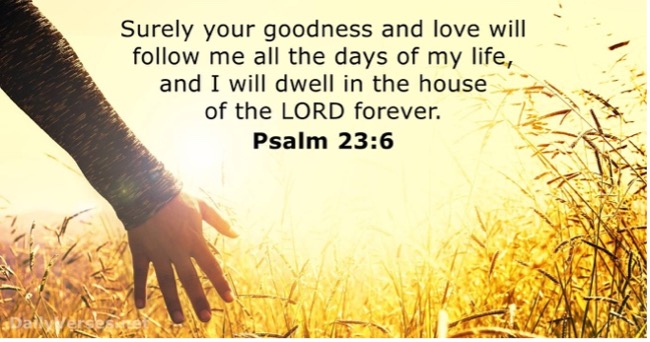
6 Surely goodness and mercy shall follow me

all the days of my life:

   and I will dwell in the house of the LORD for ever.

       So, what’s at the end of your day? How do you feel at the end of the day? Do you look forward to a better tomorrow? Do you feel like tomorrow will be more of the same? Without Jesus our “end of the days” move into more desolate places without any hope. But with Jesus every day is a new beginning. It will be a new day that is found only in Jesus your Good Shepherd and Host of the Heavenly Banquet.

       The lion and wolf seek to rip, tear, and shred you apart. Do not fear. Your Good Shepherd is with you and present with you right now. Yes. As sheep we will wander. But your faith in Jesus is what keeps you as part of His flock. Some sheep wander. They may leave the faith and flock altogether. Nevertheless, the Good Shepherd chases them down. He will leave the ninety-nine and go after the one.

       Maybe you’re one of those sheep. Maybe you have family members who have wandered away from God’s flock. Yes. This is concerning, especially for parents whose child has wandered. Yet, we hold God to His promises and pray for them.

       Maybe you’re one of those sheep who has strayed off of God’s path. Hey. We all do. We’re sheep! Rev. Dr. Paul Raabe served as professor of Old Testament at Concordia Seminary, St. Louis. He described this verse as The Good Shepherd chasing us down with His law and gospel. At the end of the day people will look for answers, and many of those answers provided by the world are not God pleasing at all. Jesus chases us down prodding us along with His rod saying, “Stay away from those sins. They’ll only separate you from the flock and you’ll get eaten alive.”

       The sheep—you and me—are completely dependent on the Shepherd. No good works will lead you through the valley to the eternal site of God’s Banquet. Only Jesus can do this. So, don’t burden yourself by wondering if you’ve done enough good things for enough people. You haven’t, and neither have I. It’s all God’s grace. I will dwell in the house of the LORD in the Hebrew is written in such a way that there is absolutely no doubt. King David had no doubt despite his sins against God and others. He trusted that God would indeed forgive him, and God did. It’s God’s grace and forgiveness in the certainty of the Good Shepherd laying down His life and taking it up for you that gives you the absolute certainty. At the end of the day there is definitely a new beginning. And Jesus is with you even at the end of the day.

Psalm 23:4 We All Walk Through Dark Valleys

4 Yea, though I walk through the valley of the shadow of death,

I will fear no evil:

    for thou art with me;

thy rod and thy staff

they comfort me.

       Let’s face it. At the “end of the day” each and every person faces death. There’s no escaping it. Psalm 23:4 speaks of the valley of the shadow of death, which is why this Psalm is read at so many funerals.

       However, this Psalm is not for those who have died, but rather for us who are still living in this desolate, present evil age. There are lots of enemies that are after God’s sheep. The devil hates the Good Shepherd, and therefore he despises His flock too. As the Bible says:

“Be sober-minded; be watchful. Your adversary the devil prowls around like a roaring lion, seeking someone to devour.” (1 Peter 5:8 ESV)

       He is the enemy of all enemies. All evil and evil ways support the devil’s goals. His goal is not to make life difficult for people. Rather, his goal is to take the sheep away from the loving care and safety of the Shepherd. His goal is to devour them—ripping, tearing, and shredding apart God’s sheep.

       As humanity travels through this world and in desolate places, there’s the Good Shepherd. And what do shepherds do for the sheep? Well, first of all they lead them. This means that the shepherd walks ahead of his flock to keep an eye out for danger, and to make sure they stay on the right path. The shepherd is also behind the flock poking and prodding them to get a move on. In addition, the shepherd will flank the flock to keep them together so that they don’t get separated and thus, vulnerable to becoming lunch for some animal.

       Nevertheless, we’re sheep and sometimes we fall off the ledge or into a hole becoming vulnerable to beasts of prey. The Good Shepherd is there to rescue us with His staff. The shepherd’s staff has a crook on the end that the shepherd uses to hook the stranded sheep under the armpits and lift it out. This is the gospel, because when we fall into sins, the loving Shepherd comes to rescue us and bring us safely back into the fold. [1]

       The rod and staff were also used by the shepherd to ward off animals who would prey on the sheep. This meant hand-to-claw—and teeth—combat where the shepherd would literally put his life on the line to protect his sheep.

       Jesus did this for you on Calvary. The Good Shepherd went head-to-head with the devil himself. It appeared that the Good Shepherd had lost the fight. But the fight wasn’t over yet. Three days later the Good Shepherd rose and stepped out of the valley of death and darkness. He conquered Satan, that prowling lion seeking whom he may devour, and now Jesus leads you through any valleys the devil puts in the way.

       What are the valleys of shadows that concern you? What are the enemies that lurk therein—hopelessness, helplessness, defeat? What are the things at the end of the day that you’re afraid of? The Good Shepherd is there with you—in the front leading you, in the rear prodding you along, and on the side flanking you from your enemies.


[1] Hans-Joachim Kraus, A Continental Commentary: Psalms 1–59 (Minneapolis, MN: Fortress Press, 1993), 308.

Psalm 23:3 Desolate Places to Green Grass

3        He restoreth my soul:

    he leadeth me in the paths of righteousness

 for his name’s sake.

       Is today a day where you could certainly use some green pastures beside some still waters? Are you seeking an exodus from the woes of this world? That was the situation of the crowd that followed Jesus and His disciples that day in the Gospel reading for the week: the Feeding of the 5,000. They carried their sick and lame friends and relatives to the other side even beating Jesus and the disciples there. Imagine carrying and transporting your sick, ill, disease-ridden relatives that distance. Imagine bringing your blind, deaf, lame, or mute friend. Imagine that you are one of these people seeking green pastures and still waters in the midst of wilderness and deserted places. This was the dire situation in which the people found themselves. They were looking for hope because they were sheep without a shepherd.

       It’s interesting to note a detail in Mark’s account of the feeding. The people come to a desolate, remote, uncultivated place. They’re looking for a Shepherd to take care of them, and they come to see Jesus. Remember, Jesus is Yhwh in the flesh. He is the LORD to Whom King David prays in Psalm 23:1.

       When we get to Mark 6:39 the desolate place is now transformed and described as green, fresh grass. Psalm 23 is definitely in the background of Mark’s account of Jesus feeding the 5,000. Jesus is God’s Deliverer of His people leading us in the New Exodus. [1] Jesus is God’s Good Shepherd leading His flock through desolate places on the way to the New Creation. Jesus is the One who encourages His sheep when we get physically, emotionally, and spiritually exhausted. He alone restores hope and joy in our soul.

       Jesus brings to life the reality of the New Exodus leading you to God’s eternal Promised Land. He leads you on God’s path of righteousness for His name’s sake, not ours. God has His reputation at stake, and He’s always good for His word. [2] He’s right here with you—right now—leading you out of desolate places to the New Creation where He has His forever green pastures and still waters waiting for you. Until then, the Good Shepherd is here with you.


[1] James W. Voelz, Concordia Commentary: Mark 1:1–8:26, ed. Dean O. Wenthe (St. Louis, MO: Concordia Publishing House, 2013), 424.

[2] Timothy E. Saleska, Psalms 1–50, ed. Christopher W. Mitchell, Concordia Commentary (Saint Louis, MO: Concordia Publishing House, 2020), 410.

Psalm 23:2 The Nestea Plunge

2.  He maketh me to lie down in green pastures:

    he leadeth me beside the still waters.

       As I write this, it’s 100 degrees here in the Grand Valley of Colorado, not untypical for summer heat in the high desert area of Western Colorado. At least it’s a dry heat. The reward comes in the evening when temperatures usually drop about 30 degrees.

       As a kid I grew up in the Midwest where there was not only the heat but add to that the humidity! But never fear. There was always Nestea Iced Tea to cool you off. Do you know about the Nestea Plunge? In the mid to late 70s Nestea ran a marketing campaign called the Nestea Plunge. You can look up the commercials online. The commercials featured someone who was in the heat, working or playing or whatever. The point was that this person was hot and sweaty, and looking for some sort of relief.

       From where did their relief come? Right on que the person has an ice-cold, ice cube filled tall glass of Nestea iced tea. They take their first drink and instantaneously they’re plunged into a pool of cool water. The point? When you’re hot, tired, and sweaty and looking for relief, take the Nestea plunge and you’ll be revived.

       There are times in everyone’s life where, at the end of the day (and during the day), the heat of our lives can take a toll. We look for relief, but where do we go? Psalm 23:2 gives the answer.

       The Good Shepherd leads you to green, fresh pastures as opposed to the deserted places with dry grass. [1] The Good Shepherd brings God’s future refreshment to you in the present through the Sacrament of Baptism. There in Baptism is where God claimed you as one of His dear little lambs. There in your Baptismal waters the Living Water, Jesus, brings you refreshment, especially on those days when you’re feeling the heat of life.  The Ancient Church Fathers remind us of this as well.

THEODORET OF CYR: He hints at the water of rebirth, in which the baptized person longs for grace and sheds the old age of sin and is made young instead of being old. COMMENTARY ON THE PSALMS 23.2.

AUGUSTINE: He nurtured me beside the water of baptism, where those who have lost their soundness and strength are made new. EXPOSITIONS OF THE PSALMS 23.1–2.

CASSIODORUS: “The water of refreshment” is the baptismal font through which the soul, barren because of the dryness of sin, is watered by divine gifts in order that it may produce good fruits. EXPLANATION OF THE PSALMS 23.2.[2]

        When you are parched and thirsty from life’s sins and the devil’s attacks, remember the cooling refreshing waters of your Baptism where God Himself plunged you into the Living Water of His Son. The Good Shepherd took the heat for you on the cross so that, even in the midst of the dryness of this world, He refreshes you with His grace and love.


[1] James W. Voelz, Concordia Commentary: Mark 1:1–8:26, ed. Dean O. Wenthe (St. Louis, MO: Concordia Publishing House, 2013), 422.

[2] Blaising, Craig A. and Carmen S. Hardin, eds., Psalms 1–50. ACCS 7. ICCS/Accordance electronic edition, version 2.6. Downers Grove: InterVarsity Press, 2008. 179.

Psalm 23:1 Looking For A Better Tomorrow?

1   The LORD is my shepherd; I shall not want.

       Have you ever come to the end of the day hoping and praying for a better tomorrow? The single parent trying to keep the family afloat while at the same time trying to have some “me” time to recharge. At the end of the day, however, the tomorrow’s hamster wheel is in full view waiting for you to jump back in tomorrow morning. The person trying to get ahead financially in this transitory inflationary economy that’s been anything but transitory. The spouse caring for his or her elderly husband or wife. Dementia, Alzheimer’s, cancer, you name it. The end of the day seems so dark and the prospects for a new beginning seem way out of reach and out of sight.

       Then Psalm 23 comes along with the opening verse. I shall not want means that I shall lack no good thing. At the end of the day this verse hits the Christian who lacks energy to go on, finances to get to the next month, the strength to endure the heartbreak of a beloved spouse who’s not going to get any better. So, what’s this verse really all about? Is there a new beginning at the end of the day?

       This Psalm is not about living the idyllic life as it’s often understood. In fact, this Psalm is just the opposite.[1] Psalm 23 is not for those who died, but for those who are still living in desolate, dark places.

       King David penned this prayer believing that Yhwh was his Good Shepherd. That means King David himself is one of His sheep. Sheep are totally dependent on the shepherd for everything—food, drink, and protection. Being a sheep is a way of life 24/7/365. There’s never a time when sheep are independent because independence from the shepherd puts the sheep in danger, or worse, death. St. Augustine wrote: “When you say, ‘The Lord is my shepherd,’ no proper grounds are left for you to trust in yourself.”[2]

       The LORD is my Shepherd, I shall lack no good thing. This seems to be an extravagant statement, especially at the end of the day when we’re looking for a new beginning. Rev. Dr. Saleska writes about this in his commentary on Psalm 23:

How can these extravagant claims be true? Is the psalmist making a prediction, “I may be lacking now, but in the future, I will not lack anything,” or is he describing his present reality, “it may look like I am suffering lack, but actually I lack nothing”? Is he reminding and encouraging himself because he is experiencing doubt? Or is he doing something else? Should the speaker’s claim be taken literally, or is it hyperbole? All are possible ways to understand the speaker’s utterance.

Regardless of the force behind the speaker’s words, God’s people tend to take his utterance not as hyperbole but—strange as it may seem to others—as literal truth. We see it as one version of a familiar profession central to our faith. A core belief is that our God is all we really need and that he is the only one able to take care of all our (other) needs. Because God promises to hold us in the hand of Christ, the Good Shepherd (Jn 10:11, 27–30), we can trust him and let go of other needs and desires. (Admittedly, though, this belief is often accompanied by doubts. We are sheep, after all.)[3]

       The Good Shepherd Jesus is Yhwh God in the flesh. This is the kind of God He is. He entered the human condition of His creation in order to bring hope and new breath into peoples’ lives. The Good Shepherd experienced everything that you do and more. He laid down His life for you on the cross. That’s how important you are to Him. And three days later He took up His life being raised from death and the grave that will eventually claim each one of us. However, death and the grave do not have the final word. Exhaustion and frustration do not have the final word. Worries and doubts do not have the final word. The Good Shepherd has the final word and that word in resurrection. In His death and resurrection Jesus has transformed the future, and He brings you that hope and certainty in your life today.

       Is there a new beginning at the end of the day? There absolutely is. Put your trust in the Good Shepherd.


[1] Hans-Joachim Kraus, A Continental Commentary: Psalms 1–59 (Minneapolis, MN: Fortress Press, 1993), 306–307.

[2] Blaising, Craig A. and Carmen S. Hardin, eds., Psalms 1–50. ACCS 7. ICCS/Accordance electronic edition, version 2.6. Downers Grove: InterVarsity Press, 2008. 178.

[3] Timothy E. Saleska, Psalms 1–50, ed. Christopher W. Mitchell, Concordia Commentary (Saint Louis, MO: Concordia Publishing House, 2020), 409–410.

Psalm 23: Can There Be A New Beginning At The End of the Day?

At The End of the Day … A New Beginning

Psalm 23 (King James Version)

A Psalm of David.

1   The LORD is my shepherd; I shall not want.

2 He maketh me to lie down in green pastures

    he leadeth me beside the still waters.

3        He restoreth my soul:

    he leadeth me in the paths of righteousness

 for his name’s sake.

4 Yea, though I walk through the valley of the shadow of death

I will fear no evil:

    for thou art with me;

thy rod and thy staff

they comfort me.

5 Thou preparest a table before me

in the presence of mine enemies:

   Thou anointest my head with oil;

my cup runneth over.
6 Surely goodness and mercy shall follow me

all the days of my life:

   and I will dwell in the house of the LORD for ever.

   Psalm 23 is probably one of the most recognized Psalms in the Bible. In fact, Psalm 23 is one of the most recognized texts in all of Scripture. This is a Psalm that is prayed by many people who seek comfort and assurance. This Psalm is read at many funerals to bring comfort to mourning family members and friends. Even marginal Christians and non-Christians recognize parts of Psalm 23: He leads me beside still waters, He restores my soul, He makes me lie down in green pastures, and He leads me through the valley of the shadow of death.

   Psalm 23’s background is that of the Exodus of God’s people when the LORD delivered them out of Egypt. Between Egypt and the Promised Land was a LOT of wilderness and desolate places—literally and figurartively. During the wilderness journey God’s people were completely dependent on Yhwh to supply their daily needs of water, food, shelter, and protection. When we read the Bible, we also read about all the times that God’s flock wandered from God’s protection and His ways thus putting themselves in danger and harm’s way. We see ourselves in this as well, because their story is our story. Nevertheless, God made a promise—a covenant—with His people, and He would not (and still does not) go back on His word to them and to you.

Propers 11; Series B–St. John’s Tide (Readings for the Week of July 21-27, 2024)

Jeremiah 23:1-6

   Here’s an instance where God’s sheep are not at fault per se. They’ve been completely misled by the religious leaders who have led them astray. To be sure, they’re guilty for wandering away from Yhwh, nevertheless, they were led astray by the very people who were supposed to shepherd them on God’s path of righteousness.

   The focus is on the “shepherds” who were preying upon God’s flock rather than shepherding and praying for God’s flock. Now, God would visit the shepherds. God Himself would make a personal inspection. And then God Himself would provide a Shepherd Who would actually care about the safety and well-being of God’s flock. This Shepherd would always be present with them, and He Himself will also go out to recover and retrieve those who are lost and gone astray. He’s the owner of the sheep after all.

Ephesians 2:11-22

   Paul’s audience for this epistle are the Gentiles. Under the Jewish practice of worship and God’s covenant, it was unthinkable that Gentiles would be considered a part of God’s flock. There were “ways” to bring a Gentile under the covenant, but this was done through a completely human perspective and work promoted by the Jewish leaders. In order for Gentiles to be brought under God’s covenant, the non-Jew would need to carry out circumcision, comply with dietary laws, and the like. In short, Gentiles would need to convert to Judaism by living Jewishly.

   However, this was not the way God laid out His plan for salvation. God’s plan for salvation is through faith in His Son, Jesus, alone. That’s it. Period. Paul reminds his Gentile audience—and us—that being a part of God’s flock is pure gift language accomplished by God’s grace. They, and we, have been brought near by the blood of Christ. “Have been brought” is passive, which means that God is the subject of the verb “to bring.” He is acting upon us, thus, we have nothing to do with this. “Near” is the adverb describing the verb “to bring.” In other words, God doesn’t bring us half-way and then we have to figure out the rest. God brings us all the way into His presence. God does so by the blood. “By the blood” is the agent, or means, by which God brings us near Him into His presence. “Of Christ” is the source of the blood. This is God’s gift to you because God provides the means and the source for you salivation. He does it all, and God does it all for you because God indeed does love you—yes, you!

Mark 6:30-44

   Psalm 23 is in the background of Mark’s account of the Feeding of the 5,000: sheep who have not been shepherded by those who were charged to do so; lost, and helpless sheep, sheep seeking a shepherd who would love them and care for them; desolate places suddenly being transformed into fresh green grass; a banquet where the people were completely filled and satiated or satisfied. Indeed, this Shepherd cares about the people in a way that other religious leaders failed to do. It was late in the day for the people—figuratively and literally. They were looking for a new beginning as the people sought a Shepherd, which is why they came to see Jesus and no one else.

COLLECT OF THE DAY (the prayer of the Church for the week)

Heavenly Father, though we do not deserve Your goodness, still You provide for all our needs of body and soul. Grant us Your Holy Spirit that we may acknowledge Your gifts, give thanks for all Your benefits, and serve You in willing obedience; through Jesus Christ, Your Son, our Lord, who lives and reigns with You and the Holy Spirit, one God, now and forever.

Baptism of Jesus; Mark 1:9-11 Jesus & ZIP Files?

Hi Family! And Happy New Year!

This is the 1st Sunday after Epiphany (Epiphany is January 6), and the Christian Church celebrates the Baptism of Our Lord. We don’t often think about Jesus’ baptism and what this means for humanity and each individual, including you and me.

I’m sure you might be wondering what this all has to do with ZIP files. Well, give a listen!

Readings for Baptism of our Lord: Genesis 1:1-5, Psalm 29, Romans 6:1-11, Mark 1:4-11

Click here for message

I love you guys! Dad

1st Sunday After Christmas; DESPOTS, Luke 2:29-32

Merry Christmas Family!

It’s still Christmas in the Christian Church. There are literally 12 Days of Christmas beginning December 25 through January 5. January 6 begins the season of Epiphany in the Christian Church. If you want to know what the song The Twelve Days of Christmas means with each of the day’s representative symbols, let me know. I’ll send you an article on it.

Today’s message for Christmas focuses on despots, despotism, and despotic authoritarian rule. This hardly seems like a Christmas message, especially given some of history’s most horrific despots: Hitler, Stalin, Mao Zedong, Pol Pot, and Kim Jong-Il. Nevertheless, Simeon’s Song from Luke 2 deals with despots, and is surprisingly very applicable to our lives today.

Christmas 1 Readings: Isaiah 61:10-62:3, Psalm 111, Galatians 4:4-7, Luke 2:22-40

Click Here for message

Have a blessed and Mighty Christmas! And a Happy New Year!

I love you guys! Dad

Advent III; Psalm 126:3-4 The Present Catches Up To the Past

Good day Family!

It’s almost Christmas! It’s just around the corner. I love Christmas, and it’s my favorite holiday of the year. I love the decorations, the Christmas music, the lights, and a whole lot of other stuff!

But Christmas is also a time to take a time-travel trip–a trip to the past. It’s what happens in the past that gives meaning to our present. And sometimes–often times–we need our present to catch up to the past.

Readings for Advent 3: Isaiah 61:1-4, 8-11; Psalm 126; 1Thessalonians 5:16-24; John 1:6-8, 19-28

Click here for the message

I love you guys! Dad