Proper 14B Psalm 34:1-10
Which Fear Surrounds You: Fears From The World or The Fear Of The LORD?
“Something’s not right.” I’ve said that to myself many times in the last few troubling and tumultuous years. I bet you have as well.” Tammy Bruce[1]
Propers for 14B
1Kings 19:1-8
There are two messengers sent to Elijah. One is from Jezebel, who instills fear of afraidness in the life of Elijah. She’s calling for his life. The other messenger is the Angel of Yhwh, the Second person of the Trinity, who comes to him, not once but TWICE. He feeds him and tells Elijah to get up and go because there’s still work that Yhwh needs him to do. The Angel of Yhwh sustains Elijah in his life despite the real dangers he faced.
Ephesians 4:17-5:2
Living in afraidness is no way to live. It sucks the joy out of living that God wants for each and every person’s life. Afraidness and living in fear robs the Christian of joy. Paul writes that the Christian is “to put off your old self, which belongs to your former manner of life … and to put on the new self, created after the likeness of God in true righteousness and holiness.” In other words, the Christian’s entire life of faith is now lived in the fear of the LORD.
John 6:35-51
Despite their fears and lack of trust that God could provide for their daily needs. God sustained the people EVERY DAY throughout their 40-year wilderness journey. Jesus is the Bread from Heaven to which He references. Jesus is also the Angel of Yhwh who sustained Elijah and told him to get up and get going. Elijah was never alone and was provided for by God’s hand. The people of God were never alone and were provided for in the wilderness by God’s hand.
Jesus said, “47 Truly, truly, I say to you, whoever believes has eternal life. 48 I am the bread of life. 49 Your fathers ate the manna in the wilderness, and they died. 50 This is the bread that comes down from heaven, so that one may eat of it and not die. 51 I am the living bread that came down from heaven. If anyone eats of this bread, he will live forever. And the bread that I will give for the life of the world is my flesh.”
“Has” is a present tense. Since Jesus has already given you eternal life today, you have nothing of which to be afraid.
COLLECT OF THE DAY
Gracious Father, Your blessed Son came down from heaven to be the true bread that gives life to the world. Grant that Christ, the bread of life, may live in us and we in Him, who lives and reigns with You and the Holy Spirit, one God, now and forever. Amen.
Psalm 34 OF DAVID, WHEN HE CHANGED HIS BEHAVIOR BEFORE ABIMELECH, SO THAT HE DROVE HIM OUT, AND HE WENT AWAY.
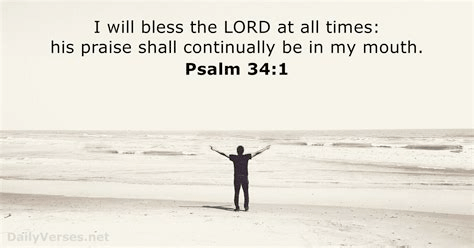
1 I will bless the LORD at all times;
his praise shall continually be in my mouth.
2 My soul makes its boast in the LORD;
let the humble hear and be glad.
3 Oh, magnify the LORD with me,
and let us exalt his name together!
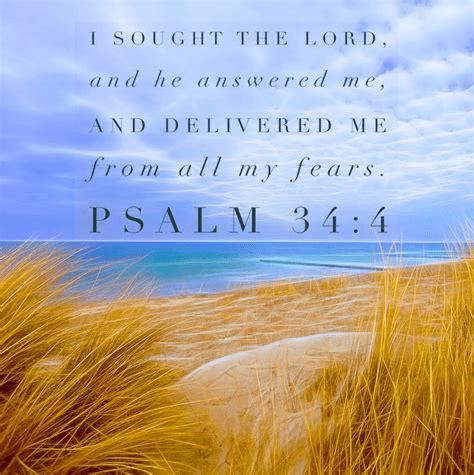
4 I sought the LORD, and he answered me
and delivered me from all my fears.
5 Those who look to him are radiant,
and their faces shall never be ashamed.
6 This poor man cried, and the LORD heard him
and saved him out of all his troubles.
7 The angel of the LORD encamps
around those who fear him, and delivers them.
8 Oh, taste and see that the LORD is good!
Blessed is the man who takes refuge in him!
9 Oh, fear the LORD, you his saints,
for those who fear him have no lack!
10 The young lions suffer want and hunger;
but those who seek the LORD lack no good thing.
Psalm 34 is one of the acrostic psalms in the Psalter. An acrostic is where the first line of the prayer or poem begins with the letter A. The next line begins with the letter B. The line after that begins with the letter C, and so forth all the way through the letter Z. A Hebrew acrostic uses the Hebrew alphabet of twenty-two letters.
In addition to being an acrostic Psalm, which David wrote, this Psalm includes an historical setting from which David penned this psalm. You might remember the story of David and Goliath from your Sunday School days (1Samuel 17)? The young, small shepherd boy went up in battle against the humongoidal Philistine Goliath. This should have been a completely one-sided victory for the Philistines, and David should have been toast. However, one should never ever count God out of the picture. God delivered Goliath over to David in victory, and in so doing David received all the attention and praise from the people.
This made King Saul rather jealous, and as the green-eyed monster of jealousy does, it moved Saul to seek out David’s life (1Samuel 18-24). In the midst of this David flees to Gath for refuge, but he needs to fake that he’s a madman and insane scratching marks on doors with his hands and drooling down his bear, well, like a madman. The king of Gath had enough crazy people to deal with. So, rather than dealing with another one, he let David go (1Samuel 21:10-15). God delivered David through this insanity, which is the setting for Psalm 34.
David certainly had something of which to fear. Nevertheless, his trust never waned in God. Rev. Dr. Saleska writes concerning this Psalm:
What David really wants to do is persuade people to believe that what Yhwh did for him is what he does for them. Put another way, he desires to blur the distinction between the miraculous thing(s) Yhwh did for him and the miraculous thing(s) he does for them. He wants to invite them to identify with him, rather than alienate them or make his experience sound more otherworldly or divine than that which they could experience. Here he does not do what many religious leaders do: he does not assert that he is qualified to lead them and that they are duty bound to follow him because God has called him for this special task.[2] David invites us to rejoice with him.
[1] Bruce, Tammy. Fear Itself (p. xi). HarperCollins. Kindle Edition.
[2] Timothy E. Saleska, Psalms 1–50, ed. Christopher W. Mitchell, Concordia Commentary (Saint Louis, MO: Concordia Publishing House, 2020), 548.





 A Redeker Respite