Friday, July 5
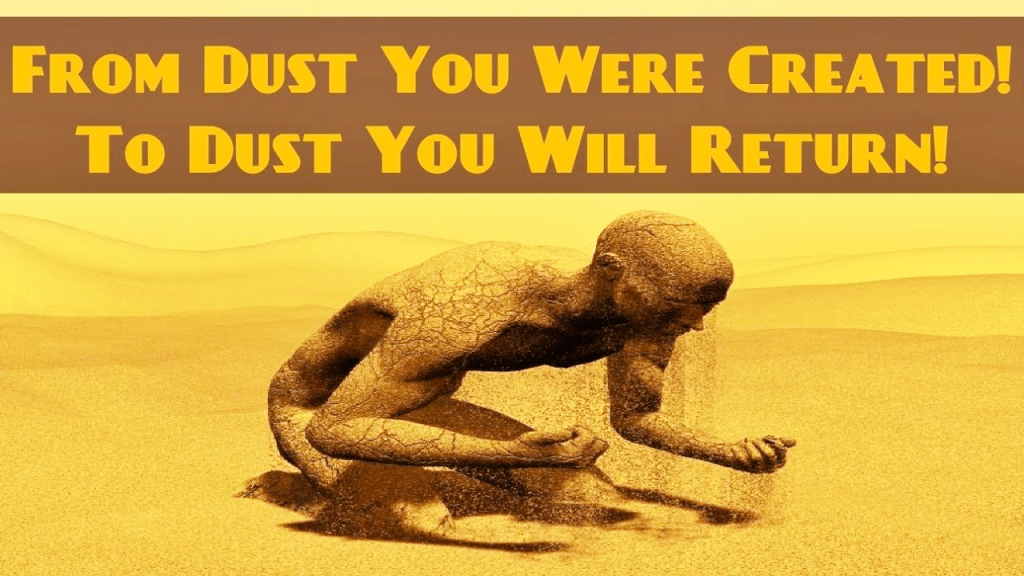
To Dust You Shall Return. The End?
- Psalm 30:8 To you, O LORD, I cry,
- and to the Lord I plead for mercy:
- 9 “What profit is there in my death,
- if I go down to the pit?
- Will the dust praise you?
- Will it tell of your faithfulness?
- 10 Hear, O LORD, and be merciful to me!
- O LORD, be my helper!”
How did Mankind come into existence? What is the purpose of Man? What’s your purpose here on this planet? Each person will answer this according to their worldview: “Is there a god? If so, what are his or her demands from me? If there is no god, then I’m in charge of my own destiny.”
Ancient religions and civilizations had their story of creation and the purpose for humankind coming into existence. Jack Klien is Professor (Emeritus) in the Department of Hebrew and Semitic Languages and the Department of Bible Studies at Bar Ilan University. He holds a Ph.D. in Oriental Studies from the University of Pennsylvania and an M.A. in the Bible from Bar Ilan University. He summarizes an ancient Sumerian composition from extant texts concerning humanity’s creation. According to the Sumerian composition it was a contest between ENKI AND NINMAḪ.
“This archaic and still partly incomprehensible myth praises Enki, the god of the subterranean fresh waters, wisdom and magic, for having planned and directed the creation of mankind and for having devised ways in which the physically handicapped could adjust to society. The myth seems to consist of two originally independent stories. The first part tells the story of the creation of man rather briefly (lines 1–43). Man was created from pieces of clay, placed in the womb of the mother-goddesses where he obtained his form and was given birth. He was created for the purpose of relieving the gods from their hard labor, and especially from digging canals for irrigation agriculture. The second part (lines 44–139) tells of a contest between the mother-goddess Ninmah and Enki during a feast celebrating man’s creation. At first Ninmah creates a number of crippled and handicapped human beings, challenging Enki to solve their problem. Enki cleverly “decrees their fate,” assigning them a function in society whereby they earn their living in an honorable way. When Ninmah gives up, it is Enki’s turn to create an abnormal creature. Enki creates a human wreck, whose nature cannot be precisely determined (either an aborted fetus or an old man), and with which Ninmah is unable to cope. The end of the second part is damaged and obscure, but it is clear that Enki prevails over Ninmah in the contest. The myth concludes with the following statement (lines 140–141): “Ninmah did not equal the great lord Enki/ Father Enki, your praise is sweet.” In spite of its fragmentary state of preservation, the myth is highly important from the point of view of the history of religion because it is the earliest composition dealing with the theme of man’s creation, and as such it is a forerunner to the First Tablet of the Babylonian Story of the Flood (see text 1.130), as well as to the two parallel stories of creation of man in the Bible (Gen 1–2).”[1]
The One true and only God created humanity for a completely different reason and purpose. We are the crown jewel of God’s creation given the privilege to worship and praise God, live in harmony and peace with Him for eternity, and be stewards of His very good Creation.
The powers of Sin, Death, and the devil turned this upside-down. Nevertheless, God’s purpose remains unchanged, including giving Him worship and praise. This is why King David says to God during his time of lament, “If You let me die and I return to the dust, how in the world can I praise you from the grave?”
Because of sin all people will die sooner or later including you and me (unless Christ returns before that). God created humanity to live forever. Little wonder we don’t relish dying and death. We heard this in the Gospel reading for this week. Jairus’ daughter was ill and on the brink of death. And because Jesus was held up by the woman in the reading today, Jesus didn’t arrive in time to heal the little girl. Jairus’ daughter succumbed to death. Not only did Jairus lament her illness, but now he lamented her death.
This is the judgment that we incurred upon ourselves. Yet God would not let the devil and death have the final word. God would still receive praise and worship from His creatures—today as well as for eternity. Death and dust are not a period. They are merely commas. Jesus is the period.
Saleska comments:
“The nation of Israel walked in this rhythm. It was in the morning, after a terrifying night, that Yhwh delivered his people from the Egyptians (Exodus 14). When the Assyrians were set to wipe out the nation, the author of 2 Kings writes: ‘And that night the angel of Yhwh went out and struck down 185,000 in the Assyrian camp. And the people arose early in the morning, and behold, these were all dead bodies’ (2 Ki 19:35). God’s ways with his people are summed up by Isaiah: ‘For a brief moment, I forsook you, but with great compassion I will gather you. In an outburst of wrath, I hid my face from you, but with everlasting love I will have compassion on you’ (Is 54:7–8).
In moving from God’s wrath to his favor, God’s people will go from weeping in the evening to a ringing cry in the morning; from sowing in tears to reaping in joy; from mourning to dancing. For us, it will be like being drawn up and out of a dark well.
… Death always seems to have the upper hand. And yet the types and shadows are not irrelevant. They get our attention and urge us to look beyond them. And when we do, we can see that they come together and end in Jesus. He is the center of the pattern. He brings coherence to these scattered fragments of hopes and dreams. What the psalmist has hinted at we see in all its glory. ‘A moment in his wrath—life in his favor’ (Ps 30:6 [5]) takes on full colors when we see the experience of Jesus at the hand of his Father, who ‘was pleased to smite him’ (Is 53:10), but then dramatically raised him from the dead (at the break of dawn, as one could have expected). And this one is alive never to die again.” …
It is true that ‘dust’ cannot praise God (30:10 [9]), and so the Father raised Jesus for the glory of his name. And it is this Word that we proclaim in song and sermon and prayer. This Word is where we put our hope. He gives a shape to ‘a moment in his wrath—life in his favor; in the evening, weeping takes lodging, but in the morning—a ringing cry’ (Ps 30:6 [5]). It is not just an abstract truth. It has its concrete incarnation in the death and resurrection of Jesus, God’s Word to the world.”[2]
[1] Hallo, William W. and K. Lawson Younger Jr., eds., Canonical Compositions from the Biblical World. COS 1, p. 516. Accordance electronic edition, version 1.0. Leiden: Brill, 2003.
[2] Timothy E. Saleska, Psalms 1–50, ed. Christopher W. Mitchell, Concordia Commentary (Saint Louis, MO: Concordia Publishing House, 2020), 500–501.
 A Redeker Respite